Published 18 October 2026
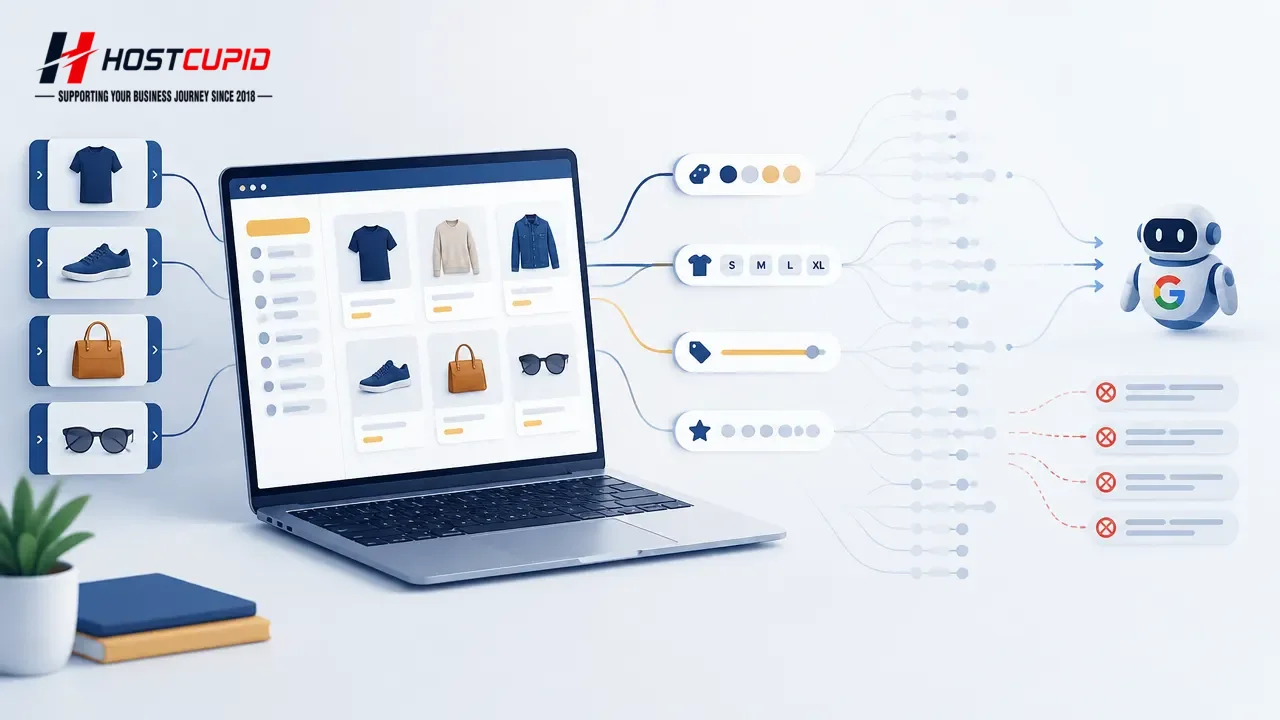
Product filters for price, colour, size or brand can make an online store easier to use. But each combination may create a separate URL, such as /shirts?colour=blue&size=m. Multiply the options and combinations, and a shop can expose a very large set of URLs that offer little distinct value to searchers.
The practical answer is not to block every filtered page by default. Decide which pages deserve to be discoverable, keep important categories accessible, and manage the rest deliberately. Google’s guidance notes that faceted navigation can create large URL spaces, increasing crawler activity and slowing discovery of useful pages. ([developers.google.com](https://developers.google.com/crawling/docs/faceted-navigation?utm_source=openai))
What are faceted URLs, and why can they matter?
Faceted navigation is a set of filters that changes the products shown on a listing page. Selecting “blue”, then “medium”, then “under ₹2,000” may produce a new URL for each state. If a store allows many filters to be combined or reordered, the same product set may appear at multiple URLs.
This matters operationally as well as for search. A crawler may spend requests fetching numerous low-value combinations, while product pages or newly updated categories still need to be discovered. It can also create confusing analytics and duplicate-looking landing pages. Google cautions that crawl activity on filter URLs can consume site resources; that is a possibility to investigate, not proof that every shop is suffering a crawl problem. ([developers.google.com](https://developers.google.com/crawling/docs/faceted-navigation?utm_source=openai))
Important: “Block from crawling” and “keep out of search results” are not the same instruction. A robots.txt block can stop Google from fetching a page, but the URL may still appear in results if discovered elsewhere. For a page that must be removed from Google’s index, Google says to use an accessible
noindexdirective or password protection—not a robots.txt block that prevents Google from seeing the directive. ([developers.google.com](https://developers.google.com/search/docs/crawling-indexing/robots/intro?hl=en&rd=1&visit_id=639272119015520944-4239214390&utm_source=openai))
Which filtered pages should remain discoverable?
Start with shopper and business value. A filter page that presents a genuinely useful, stable selection—such as “cotton kurtas” or “laptops under ₹50,000”—might merit a clean, linkable landing page if it has sufficient products and distinct content. A page that only changes sort order, session state or a temporary tracking value rarely needs to be a separate search destination.
Use this decision check before changing URL rules:
- Keep discoverable: useful category and product pages with stable inventory and a clear audience.
- Review carefully: popular filter combinations that shoppers may search for and that have enough unique value to justify a landing page.
- Usually constrain: endless combinations, repeated parameters, session identifiers, sort orders and empty-result filters.
- Never hide casually: product or category URLs that are important to customers, internal navigation or marketing campaigns.
Google’s ecommerce guidance recommends helping crawlers reach products through ordinary links, such as category-to-subcategory-to-product links. A search box alone may not expose products because Googlebot generally does not submit queries into the site search box. A sitemap can provide another discovery route, but it is a hint rather than a guarantee of crawling or indexing. ([developers.google.com](https://developers.google.com/search/docs/specialty/ecommerce/help-google-understand-your-ecommerce-site-structure?hl=en&utm_source=openai))
Choose the right control for the problem
Do not use canonical tags, robots.txt and noindex as if they did the same job. A canonical tag signals which URL is preferred among duplicate or similar pages; it does not prevent a crawler from fetching the alternate URL. Robots.txt manages crawling access. A noindex instruction requests that a crawlable page be excluded from search results.
For filtered URLs that do not need to appear in Google, Google’s faceted-navigation guidance describes robots.txt as one option to reduce crawling. If you want a filter page indexed, use a consistent URL pattern and make sure it provides useful results. For duplicate or near-duplicate versions, a canonical preference may help communicate the preferred URL over time. ([developers.google.com](https://developers.google.com/crawling/docs/faceted-navigation?utm_source=openai))
A safe audit before editing robots.txt
- Collect real URLs. Review category links, store search/filter behaviour, server logs and Search Console examples. Group URLs by parameter, such as colour, size, sorting or tracking.
- Classify their purpose. Mark each group as useful landing pages, duplicate views, operational pages or empty results. Check that important products remain reachable through category links and the sitemap.
- Inspect current signals. Check robots.txt, canonical tags and any page-level
noindexdirectives. Make sure these controls do not contradict one another or block the crawler from seeing a directive you expect it to read. - Make a narrow change. If filtering URLs should not be crawled, add only the rules needed for the verified parameter patterns. Avoid broad rules that could also block product pages, images, scripts or valuable categories.
- Test before and after. Try representative URLs in Search Console’s URL Inspection and robots.txt testing tools where available. Confirm the user-facing filters still work, important pages return the expected status, and the sitemap lists the preferred URLs.
- Monitor the result. Watch crawl examples, indexing reports, server logs and customer journeys after deployment. If discovery or indexing of a valuable page worsens, revisit the rule and roll it back if necessary.
What Indian store owners should take away
For a small catalogue, filter URL sprawl may be limited; a complex robots.txt project may not be worthwhile. For a large catalogue or a store with many combinations, a careful review can help reduce unhelpful crawl paths while preserving useful product discovery. Do not expect a robots.txt edit alone to improve rankings, and do not block a URL merely because it contains a question mark.
HostCupid Web Solutions Private Limited is a Chennai-based company providing ecommerce and website solutions, hosting and migration assistance. For a store being developed or moved, this issue is a useful part of launch QA: test the actual filters, confirm product pages are internally reachable, and check that crawl controls match the store’s intended search visibility. The appropriate rules depend on the platform and URL behaviour; validate them on the live configuration before applying them broadly.
The goal is a catalogue that remains easy for shoppers to browse and clear for crawlers to navigate: expose pages with distinct value, reduce accidental URL duplication, and verify the effect rather than relying on assumptions.
Sources
- Managing crawling of faceted navigation URLs · 2025-12-18
- Help Google understand your ecommerce website structure
- Block Search indexing with noindex
- Build and submit a sitemap
- How to specify a canonical URL with rel="canonical" and other methods